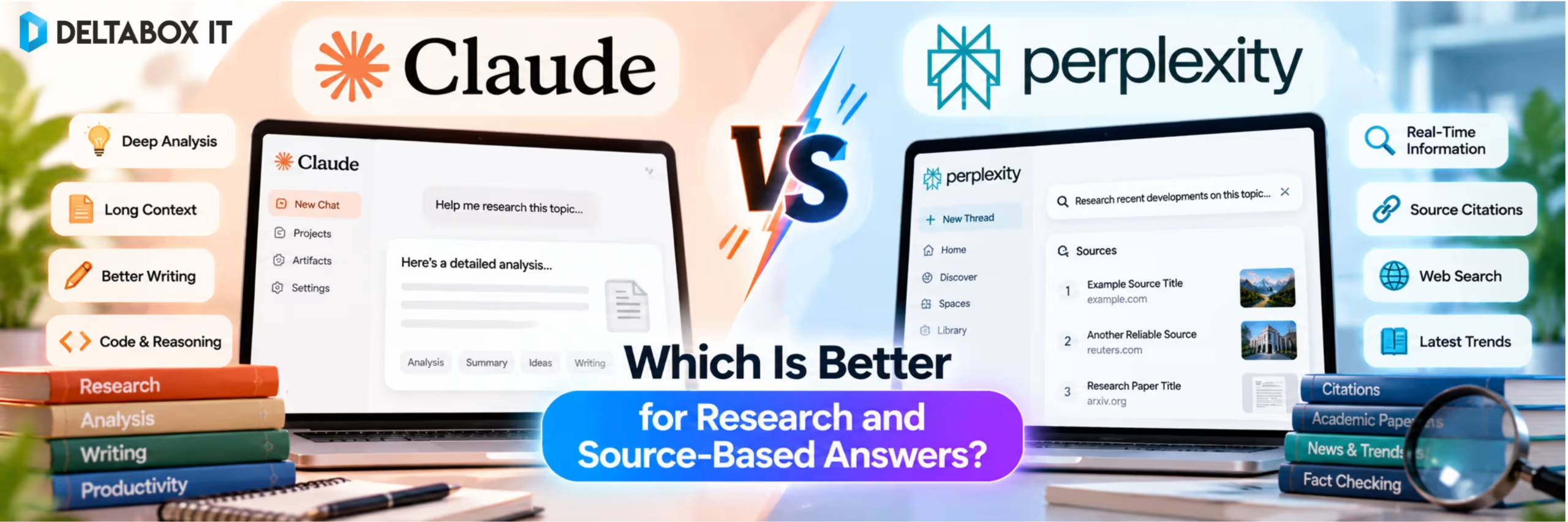

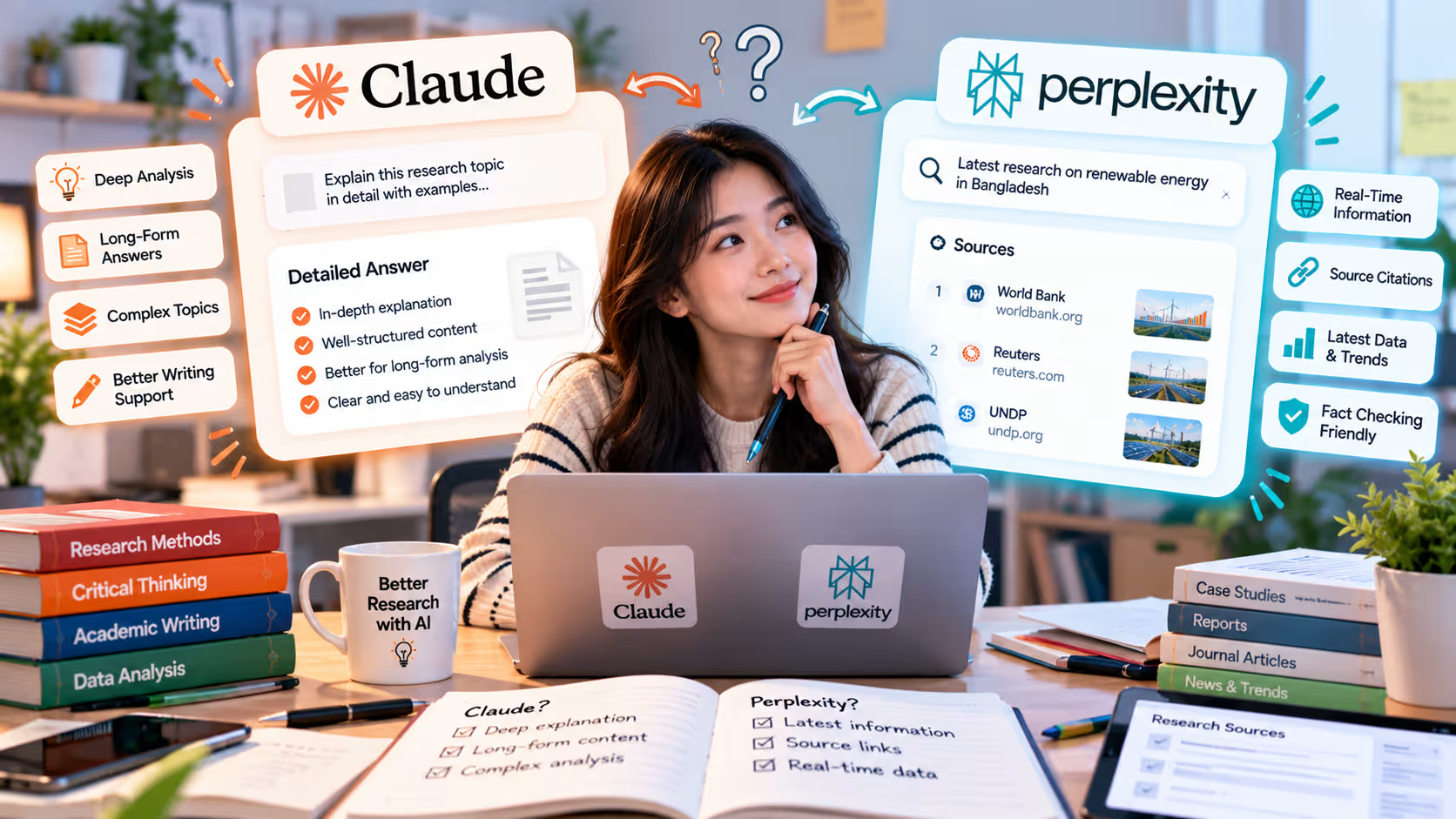
Claude and Perplexity can both search the web, work with documents and produce answers supported by sources. But they approach research from different directions.
Perplexity is built around search and source discovery. You ask a question, it searches the web, synthesises information and places citations directly alongside the answer.
Claude is a broader AI assistant with strong research capabilities. It can search the live web with citations, conduct multi-step Research, analyse your files and combine external information with connected work context.
That means the Claude vs Perplexity decision is less about which AI can research and more about what happens after you start researching.
If your main task is:
“Find the relevant sources and show me where the information came from.”
Perplexity is usually the more natural starting point.
If your task is:
“Study these sources, compare the arguments and turn the findings into a detailed report or structured analysis.”
Claude can be the stronger fit.
Quick Answer: Claude or Perplexity for Research?
| Research Need | Better Starting Point |
|---|---|
| Quick source-backed web answer | Perplexity |
| Discover many relevant sources | Perplexity |
| Academic source discovery | Perplexity |
| Analyse several supplied documents | Claude |
| Deep synthesis and long-form reasoning | Claude |
| Research across web + connected work context | Claude |
| Compare different AI models during search | Perplexity Pro |
| Turn research into polished writing | Claude |
| Current information with citations | Both |
The practical distinction is:
Perplexity is search-first. Claude is reasoning-and-synthesis-first.
How Claude Handles Research
Claude is no longer limited to answering from its training data.
Web search allows Claude to retrieve current information from the internet and provide direct citations to the sources it uses. When a question requires more than a simple search, Claude can perform multiple searches and refine its investigation based on what it discovers.
Paid Claude plans also provide a dedicated Research mode.
Research works more agentically than a normal web search. Claude breaks a question into smaller areas, investigates them separately and then combines the findings into a longer source-backed response.
This makes Claude useful for tasks such as:
- Competitor and industry analysis
- Literature exploration
- Technical research
- Policy comparison
- Market research
- Multi-document synthesis
Claude can also combine web research with information from supported connected services and integrations.
For example, a business user could ask Claude to analyse current industry developments while also considering internal documents or relevant work context.
That combination of external research + supplied context + detailed synthesis is one of Claude’s most useful research strengths.
How Perplexity Handles Research
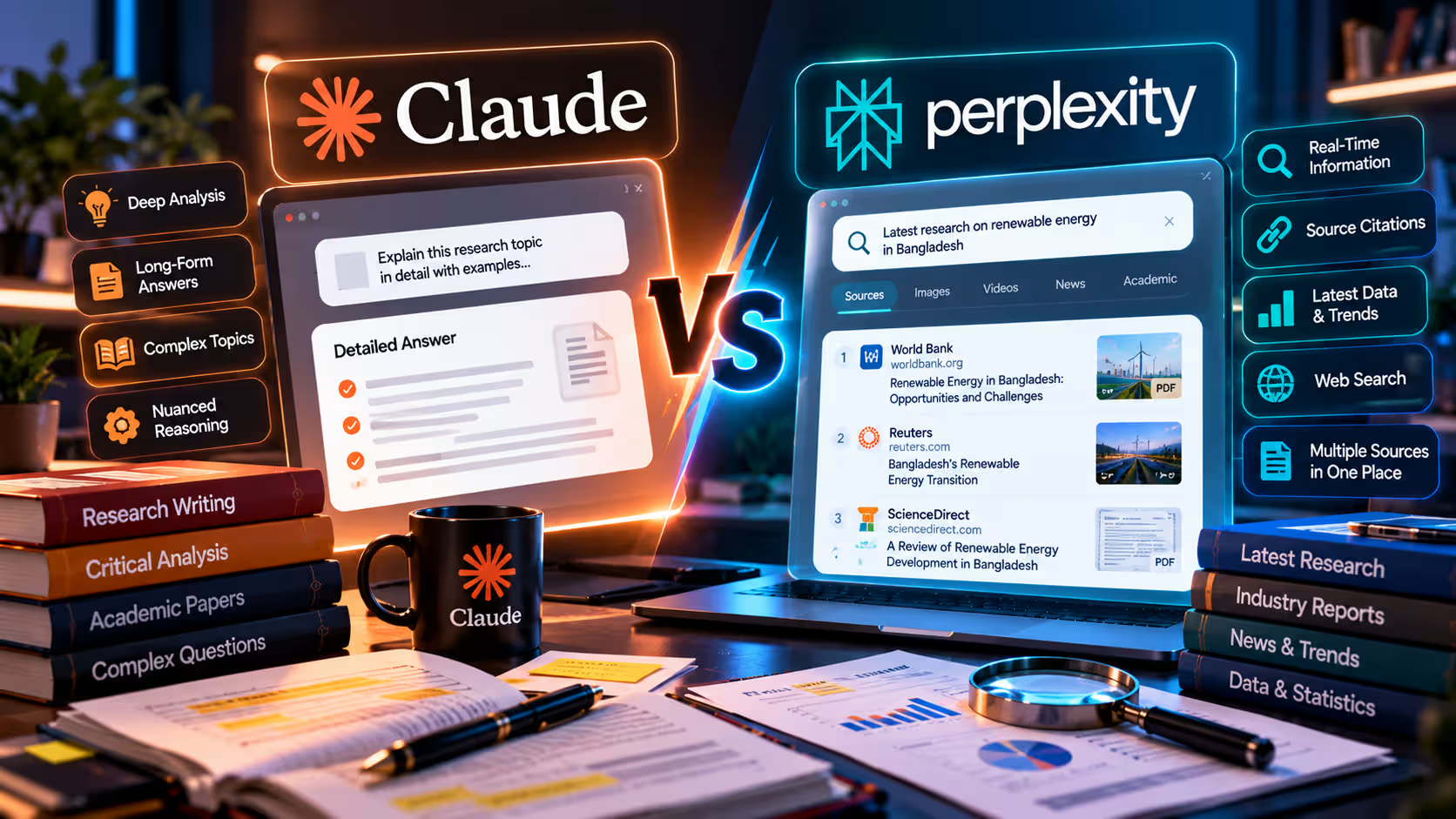
Perplexity was designed around information retrieval from the beginning.
Its standard search experience takes a question, searches current sources and returns a conversational answer with links that allow you to inspect where individual claims came from.
For straightforward research, this creates a very efficient workflow:
Question → Answer → Citation → Original Source
Perplexity Pro expands that workflow through Pro Search and Research.
Pro Search can perform several searches, evaluate different sources and synthesise a more detailed answer. It can also focus searches on different types of information, including Web, Academic, Finance and uploaded Files.
That source-oriented interface is particularly useful when the research goal is not just receiving an answer but finding material you may want to read yourself.
Perplexity Pro also allows users to choose among supported advanced AI models while keeping Perplexity’s search and citation system around the answer.
For users whose work begins with finding evidence, Perplexity feels closer to an AI-powered research engine than a general chatbot.
Claude vs Perplexity for Source Discovery
Source discovery is where Perplexity has the clearest advantage.
Suppose you are researching:
“How is generative AI changing online education?”
Perplexity can quickly surface reports, articles, academic material and other web sources while showing citations throughout the answer.
You can open those references, identify useful publications and continue refining the search.
Claude can also search the web and cite its sources, but its interface is generally more oriented toward answering and reasoning over the information it finds.
That makes Perplexity especially practical when you want to:
- Build an initial reading list
- Locate supporting evidence
- Find multiple perspectives
- Discover recent reports
- Trace a factual claim to its source
Claude becomes more useful when you already have those sources and want deeper comparative analysis.
Which Is Better for Academic Research?
For initial academic source discovery, Perplexity has the more specialised workflow.
Perplexity Pro Search can focus on academic material, making it useful for locating papers and exploring scholarly topics before moving into formal academic databases.
A student researching remote-work productivity, for example, could use Perplexity to identify relevant papers and major themes quickly.
Claude can also support academic research through web search, Research and uploaded documents.
Its strength becomes clearer after the papers have been identified.
You might upload several articles and ask:
Compare the methodologies, sample sizes, conclusions and limitations across these studies. Identify where the findings agree and where they conflict.
That type of synthesis fits Claude particularly well.
A useful academic workflow can therefore be:
Perplexity for discovery → original databases for verification → Claude for close analysis and synthesis.
Neither platform should replace Google Scholar, PubMed, Scopus, Web of Science or other databases required by your institution.
Which Is Better for Reading PDFs and Long Documents?
Both platforms can analyse uploaded files.
Perplexity Pro supports higher file-upload and analysis limits than its free plan and can combine uploaded material with search.
This is useful when a document is one source within a wider investigation.
Claude is particularly well suited to workflows where the supplied documents themselves are the central material.
For example, you could provide reports, policy documents or papers and ask Claude to:
Identify contradictions between these files, create a comparison framework and write an executive summary using only the supplied material.
That makes Claude useful for research where interpretation and synthesis matter more than discovering additional web pages.
The choice therefore depends on the question:
Need more sources? → Perplexity
Need more analysis of the sources you already have? → Claude
Which Gives Better Citations?
Both can provide citations, but citation design is more central to Perplexity’s identity.
Perplexity Search is designed around source-linked answers. Pro Search expands the number and range of sources used for deeper investigations.
Claude’s web search also includes direct citations, and its Research mode produces source-backed reports.
However, no citation system guarantees that an AI has interpreted the source correctly.
A response may cite a real article but still oversimplify its conclusion or miss an important limitation.
For serious research, always open the primary source.
Do not cite an AI-generated summary when you could cite the original paper, report, regulation or official documentation.
Claude vs Perplexity for Writing Research Reports
This is where Claude often becomes more useful.
Once the source-gathering phase is complete, research usually needs to become something else:
A briefing, literature review, comparison, strategy document or client report.
Claude’s broader writing and reasoning workflow makes it a strong option for transforming research material into structured long-form output.
For example:
Using these six reports, create a 1,500-word market analysis. Separate confirmed evidence from interpretation and cite the supplied sources beside each major finding.
Perplexity can also generate reports, particularly through Research and its newer creation tools.
But if your workflow involves repeated revision, tone control, detailed restructuring and close work with documents, Claude may feel more natural.
This is not an accuracy guarantee. It is a workflow difference.
Can Perplexity Use Claude Models?
Yes, eligible Perplexity paid plans provide access to several advanced model families, which can include Anthropic’s Claude models.
That creates an interesting question:
If Perplexity can use Claude, why subscribe to Claude separately?
Because the model and the product are not the same thing.
When you select a Claude model inside Perplexity, Perplexity still controls the search infrastructure, source retrieval, interface and surrounding research workflow.
Using Claude directly gives you Anthropic’s own Claude experience, Research mode, supported integrations and native document workflow.
So:
Claude inside Perplexity ≠ the full Claude application.
Choose based on the workflow you need, not only the model name displayed in a selector.
Which Is Better for Students, Researchers and Professionals?
Students doing general assignments and source discovery may find Perplexity easier because citations are visible from the beginning.
Researchers working through many documents may benefit more from Claude’s synthesis workflow.
Content writers and SEO professionals can use Perplexity to find statistics, primary sources and competing viewpoints, then use Claude to analyse the material and develop a detailed brief.
Business users researching current markets may also combine the two: Perplexity for rapid evidence gathering and Claude for deeper strategic interpretation.
You do not necessarily need both subscriptions.
Start with the stage of research that consumes the most time.
Claude Pro and Perplexity Pro in Bangladesh
Bangladesh users can review Claude Pro subscription options through DeltaBox IT when Claude’s document analysis, writing and broader research workflow fit their needs. Check the live page for current availability, account type and package conditions before ordering.
For users whose priority is citation-heavy web research and source discovery, DeltaBox IT also lists Perplexity Pro subscription options.
The current Perplexity offering includes different access models, so privacy matters. Shared access should not be used for confidential client information, unpublished research or other sensitive files. A personal account environment is more appropriate for that type of work.
If you are still deciding between several AI platforms, compare the broader AI tools available through DeltaBox IT.
DeltaBox IT is an independent third-party digital subscription provider and does not own or operate Anthropic, Claude or Perplexity.
Frequently Asked Questions
Is Claude Better Than Perplexity for Research?
Claude is particularly useful for analysing documents, synthesising information and turning research into detailed written outputs. Perplexity is generally more specialised for finding sources and producing citation-backed web answers.
Is Perplexity Better for Academic Research?
Perplexity is useful for preliminary academic source discovery because Pro Search can focus on academic sources. Important papers should still be verified through the original publication or recognised scholarly database.
Can Claude Search the Internet?
Yes. Claude supports live web search with citations. Paid plans also provide Research mode for deeper multi-step investigations.
Does Perplexity Always Provide Sources?
Source-backed search is a core part of Perplexity’s experience. However, users should still open and evaluate the original sources before relying on important claims.
Can I Upload PDFs to Both Claude and Perplexity?
Yes. Both support file-based workflows. Claude is often useful when deep analysis of supplied documents is the main task, while Perplexity can combine uploaded files with its search-oriented workflow.
Final Verdict
Choose Perplexity when your research starts with:
“Find the strongest sources for this question.”
Choose Claude when it starts with:
“Help me understand, compare and synthesise these sources.”
For source discovery, quick citation-backed answers and academic exploration, Perplexity has the more purpose-built experience.
For document analysis, deeper synthesis and turning research into a polished report, Claude has the stronger workflow fit.
For demanding research, they can also complement each other:
Perplexity discovers the evidence. Claude helps you work deeply with it.