


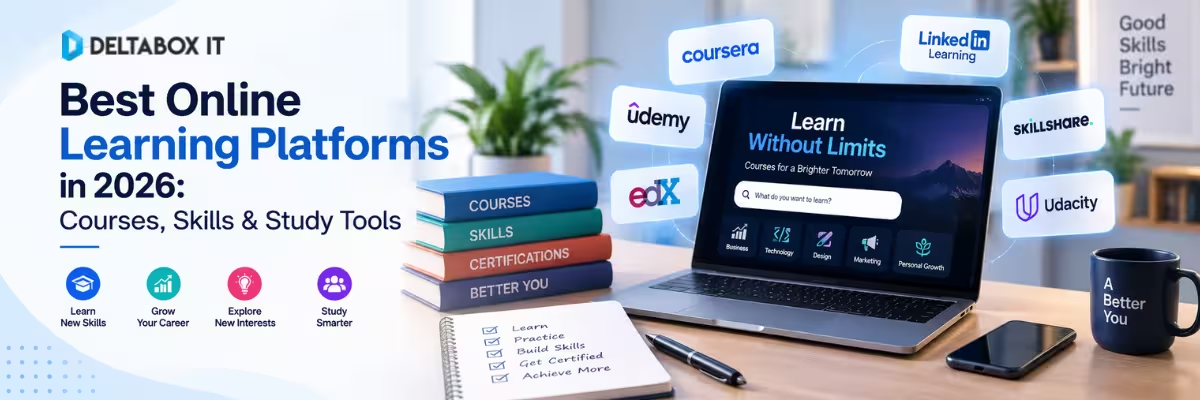
Best Online Learning Platforms in 2026: Courses, Skills & Study Tools

The problem with online learning in 2026 is not access.
It is choice.
A student who wants to learn Python can choose between Codecademy, Coursera, YouTube, Udemy and several free coding platforms. Someone preparing for an exam may benefit more from Quizlet or StuDocu than from a traditional course platform. A learner trying to improve a language has a completely different requirement again.
That is why asking for the single best online learning platform usually produces the wrong answer.
The better question is:
What are you trying to learn, how do you want to learn it, and what do you need at the end?
If you need structured professional courses and credentials, Coursera belongs near the top of the shortlist. If you learn programming best by writing code directly in the browser, Codecademy solves a different problem. Quizlet is built around study and recall. Duolingo focuses on language learning. StuDocu and Course Hero are closer to course-specific study-resource platforms, while MasterClass is built around expert-led learning rather than a conventional academic curriculum.
This guide compares the major types of online learning platforms for students, professionals and self-directed learners so you can choose a platform based on the outcome—not simply the brand.
Quick Answer: Which Online Learning Platform Is Best?
There is no universal winner. The best platform depends on what you need to accomplish.
| Your Goal | Strong Starting Option | Why |
|---|---|---|
| Structured professional learning | Coursera | Courses, programs, projects and credentials |
| Learn programming interactively | Codecademy | Browser-based coding, paths and projects |
| Learn a language consistently | Duolingo | Short lessons and habit-based practice |
| Flashcards and exam revision | Quizlet | Active recall, Learn and Test modes |
| University notes and course materials | StuDocu | Course-specific student resources |
| Study documents and homework support | Course Hero | Course materials and learning resources |
| Document reading | Scribd | Large user-uploaded document library |
| Learn from recognised experts | MasterClass | Expert-led video learning |
| Discover and follow research | Academia.edu | Academic search and research-network features |
| Free foundational learning | Khan Academy / other free resources | Useful when a paid credential is unnecessary |
For most learners, the right strategy is not subscribing to several platforms at once. Pick one platform that matches the current learning goal, complete a meaningful course or study cycle, and add another tool only when the workflow genuinely requires it.
How We Evaluated the Platforms
This is not a laboratory ranking where every platform receives an arbitrary score out of ten.
Coursera and Quizlet cannot be fairly evaluated as though they perform the same job. One is primarily a structured course ecosystem; the other is a study and retrieval-practice platform.
Instead, the comparison focuses on practical learner questions:
- What type of learning does the platform support?
- Is the experience structured or self-directed?
- Does the learner practise or mostly consume content?
- Are certificates or credentials relevant?
- Does the platform work for university study?
- Can a beginner start without immediately paying?
- Does premium access remove a meaningful limitation?
- Is the platform suitable for a student, career learner or professional?
- What should a Bangladeshi buyer verify before purchasing?
Current feature statements have been checked against official platform documentation where applicable. Features, catalogues and subscription rules can change.
1. Coursera: Best Fit for Structured Courses and Career Learning
Coursera is one of the strongest starting points when the learner wants structured education rather than isolated tutorials.
Its platform includes individual courses, projects, Specializations and Professional Certificate programs across areas such as technology, business, data, AI and professional development. Coursera Plus currently provides access to thousands of eligible courses and programs under one subscription, although not every Coursera offering is included.
The important distinction is structure.
A learner who searches YouTube for “learn data analytics” may find hundreds of useful videos but still struggle to decide what comes next. Coursera’s programs can provide a clearer sequence.
That makes it useful for:
- Career development
- Structured skill learning
- Professional certificates
- Business and technology topics
- Learners who prefer defined progression
Where Coursera Is Less Necessary
If you only need one narrow skill or one tutorial, a full subscription may be unnecessary.
Likewise, paying for certificates has limited value when you only want knowledge for personal use.
Best fit: students and professionals who want structured learning and potentially shareable credentials.
Students in Bangladesh who need regular course access can review the current Coursera Plus subscription options.
2. Codecademy: Best Fit for Learning Coding by Doing
Watching someone write code is not the same as writing it yourself.
That distinction is where Codecademy becomes useful.
Codecademy’s learning environment is built around interactive coding. Current paid plans include courses, projects and Skill Paths, while the Pro tier adds career-oriented functionality such as Career Paths and additional job-readiness features.
Instead of completing an hour of video before touching a code editor, learners interact with code throughout the lesson.
That format is particularly useful for subjects such as:
- Python
- JavaScript
- HTML and CSS
- SQL
- Web development
- Data-related skills
- Computer-science fundamentals
Codecademy vs General Course Platforms
Coursera may be the stronger fit when you want a broader structured program or credential.
Codecademy becomes more compelling when the immediate objective is:
Learn the concept, write the code, practise it, then build something with it.
For a beginner deciding whether programming is actually right for them, starting with Codecademy’s free material is sensible before paying for Pro.
Current DeltaBox IT access details are available on the Codecademy Pro subscription page.
Important for DeltaBox IT buyers: the current shared Codecademy package should be evaluated as learning access. A certificate or certification is not issued in the customer’s own name under that shared-account setup.
3. Duolingo: Best Fit for Building a Language-Learning Habit
Language learning requires repetition.
A platform you use for three hours once and then abandon for a month is less useful than one that gets you practising consistently.
Duolingo’s model is built around short, recurring lessons and progress habits. The core courses remain accessible without a paid subscription. Super Duolingo primarily improves the learning experience with features such as removing ads, unlimited Hearts and additional practice options; Duolingo Max is a separate higher tier with additional AI-powered features.
This matters for purchase intent.
Paying for Super does not mean the free version suddenly becomes educationally useless.
Stay with Free When
You can tolerate ads and the normal Hearts system and are progressing consistently.
Consider Super When
Ads, Hearts or practice limitations are repeatedly interrupting a learning habit.
For Bangladesh users, the current DeltaBox IT package activates Super Duolingo through the supported access process while keeping the learner’s existing profile and progress.
The deeper Duolingo Free vs Super question should be handled in its own comparison article rather than turning this pillar into a subscription review.
4. Quizlet: Best Fit for Active Recall and Exam Preparation
Reading notes repeatedly can feel productive without proving that you can actually recall the material.
Quizlet approaches studying differently.
Its platform centres on flashcards and practice, while Learn can turn study sets into adaptive questions and Test mode can generate practice assessments using different question formats.
That makes Quizlet relevant for:
- Vocabulary
- Definitions
- Medical terminology
- Formulas
- Exam review
- Quick factual recall
- Repeated practice
The key learning concept is retrieval practice: trying to produce the answer instead of simply rereading it.
Quizlet is therefore not a direct alternative to Coursera.
Coursera teaches through courses.
Quizlet helps you study material you need to remember.
Students who use it regularly can review the current Quizlet Plus options in Bangladesh.
5. StuDocu: Best Fit for Course-Specific University Resources
StuDocu solves another problem entirely.
Instead of teaching a broad topic from the beginning, it helps students find resources connected to particular institutions and courses.
Its current platform includes student-created lecture notes, summaries, past exams, flashcards and other course-specific materials. StuDocu also layers AI study functions over uploaded or available materials, including quizzes, summaries and mock-exam style workflows.
This can be useful when a student wants to understand:
- How a particular subject has been organised
- What other students included in their notes
- How previous assessment material was structured
- Which topics may require additional revision
But course-resource platforms need responsible use.
A useful document should support your understanding. It should not become something you copy and submit as your own work.
StuDocu Is Not a Substitute for the Course
A lecturer’s requirements, assigned reading and institution-specific academic policies still take priority.
Students who need access to available Premium resources can review the StuDocu Premium subscription.
6. Course Hero: Best Fit for Study Resources and Course Support
Course Hero also operates around course-specific learning resources.
Its official support documentation describes materials including study guides, class notes, practice problems, textbook solutions and explanations, as well as homework-help resources.
The practical difference from a traditional course platform is important.
You would not normally choose Course Hero because:
“I want to start learning Python from zero.”
You might choose it because:
“I am already taking a university course and need additional materials to understand the subject.”
That positions Course Hero closer to the study-support layer than the course-teaching layer.
Academic-integrity rules still apply. Study materials should help the learner understand concepts, not replace original assignments.
Current access can be reviewed through the Course Hero Premium subscription.
7. Scribd: Best Fit for Broad Document Reading
Scribd is another platform that should not be confused with Coursera or Codecademy.
It is primarily a large document platform containing community-uploaded material across academic, professional and general topics. Scribd’s current paid membership adds benefits such as ad-free document access and downloads where the contributor has enabled downloading. Everand is now the separate Scribd Inc. product associated with ebooks and audiobooks.
For students, that can make Scribd useful for:
- Browsing documents
- Reading reference material
- Presentations
- Manuals
- Study-related documents
However, availability matters.
A subscription does not mean every document can be downloaded. Uploaders can control document-download permissions.
That is why Scribd should be positioned primarily as a reading and document-discovery tool, not as a guaranteed downloading service.
Current package conditions are available on the Scribd Premium subscription page.
8. MasterClass: Best Fit for Expert-Led Learning and Inspiration
MasterClass occupies an unusual position in online education.
It is less like a traditional university course library and more like an expert-led learning experience.
Its regular catalogue contains classes taught by recognised practitioners across areas such as writing, business, cooking, film, design, sports and other creative or professional subjects. MasterClass says its main class library includes more than 200 classes, generally designed for self-paced viewing.
That makes it attractive when the learner wants to study:
- How experienced professionals think
- Creative processes
- Decision-making
- Craft
- Career perspective
- Practical inspiration
What MasterClass Is Not
Do not choose regular MasterClass membership primarily because you need a conventional university credential.
MasterClass now has separate Certificate Course products, but these are distinct from ordinary membership classes.
For DeltaBox IT customers specifically, the current shared MasterClass package should be considered access to the available membership learning catalogue—not a customer-name certificate package.
Best fit: self-directed learners who value expert perspective and high-quality instructional content more than conventional academic credentials.
9. Academia.edu: Best Fit for Research Discovery, Not General Skill Courses
Academia.edu is included here for a different reason.
It is not a conventional online course platform.
Its role is closer to academic discovery and researcher networking. Free users can search, read available uploaded material and maintain profiles, while Premium adds functionality such as advanced search, search filters, alerts and deeper analytics.
One detail is particularly important:
Academia Premium does not magically unlock missing portions of a paper that were never uploaded to the platform. Its Premium search tools improve discovery and filtering rather than buying access to nonexistent document pages.
That makes Academia.edu more relevant to:
- Researchers
- Postgraduate students
- Academics
- Users following specific research topics
- Authors monitoring engagement with their own work
It is much less relevant to someone whose main goal is learning Photoshop, Python or spoken Spanish.
Current access details are available through the Academia.edu Premium subscription.
Course Platforms vs Study Platforms: Know the Difference
A major source of poor buying decisions is treating every educational website as the same type of product.
They are not.
| Platform Type | Main Job | Examples |
|---|---|---|
| Structured course platform | Teach a skill through organised lessons | Coursera |
| Interactive skill platform | Teach through direct practice | Codecademy |
| Language-learning platform | Build language knowledge and practice habits | Duolingo |
| Active-study platform | Help recall and test knowledge | Quizlet |
| Course-resource platform | Provide supporting course materials | StuDocu, Course Hero |
| Document platform | Provide broad document discovery and reading | Scribd |
| Expert-learning platform | Teach through practitioner-led content | MasterClass |
| Academic-discovery platform | Find and follow scholarly work | Academia.edu |
A student may eventually use more than one category.
But the categories should not be purchased as though they are interchangeable.
Best Online Learning Platform by Goal
Instead of ranking every platform from first to ninth, start with the outcome.
If You Want a Career Skill
Start with a structured learning platform such as Coursera.
If the skill is programming-heavy, also evaluate Codecademy’s interactive model.
The deciding question is whether you learn better through a course sequence or through direct technical practice.
If You Want to Learn Coding
Codecademy is one of the clearest options for hands-on learning.
Coursera may make more sense when you want a broader technical program, university/company-backed coursework or a more conventional certificate pathway.
Free resources such as freeCodeCamp and other coding curricula can also be excellent when budget matters more than credentials.
Do not collect five coding subscriptions.
Choose one path and build projects.
If You Are Preparing for Exams
Quizlet becomes more relevant than a general course marketplace when the material is already defined and your main problem is remembering it.
StuDocu or Course Hero can then support course-specific preparation where appropriate resources exist.
This combination serves a different purpose from buying another online course.
If You Are Learning a Language
Try the free version of Duolingo first.
The paid Super tier becomes a workflow decision: are ads, Hearts or practice restrictions consistently interfering with your routine?
If not, Free can remain perfectly reasonable.
If You Want Creative or Professional Inspiration
MasterClass is more suitable than a conventional academic platform when the goal is to learn how experienced practitioners approach their craft.
If you need an employer-recognised technical credential instead, use a platform built around that outcome.
Free vs Paid Online Learning: When Should You Upgrade?
A paid platform should remove a real limitation.
Free learning is often enough when you are exploring whether a subject interests you.
For example, you do not need to buy a coding subscription on the first day you decide to learn Python. Test the teaching style first.
| Situation | Free May Be Enough | Paid Access Becomes More Useful |
|---|---|---|
| Exploring a new subject | Yes | Usually unnecessary initially |
| Casual language learning | Often | When premium friction affects consistency |
| Learning basic coding | Often | Structured paths/projects can add value |
| Exam preparation | Depends | Paid study modes may help frequent users |
| Career transition | Limited | Structured programs can become more useful |
| Need a credential | Often insufficient | Paid completion/certificate access may matter |
| Regular course-resource use | Limited | Subscription can become practical |
| Professional upskilling | Depends | Useful when learning is continuous |
The right time to pay is when you can explain exactly what the subscription will help you do that your current setup cannot.
Certificates vs Skills: Do You Actually Need Both?
Online learners often overestimate certificates and underestimate evidence of actual skill.
A certificate can be useful when:
- An employer recognises the program
- It supports a job application
- Professional development needs documentation
- The learner needs structured accountability
But a certificate alone does not prove mastery.
For coding, a working project may be more persuasive than a folder full of completion badges.
For design, the portfolio matters.
For language learning, actual comprehension and communication matter.
For university study, the grade and understanding matter more than owning a premium study app.
The best learning outcome combines knowledge + practice + evidence.
Online Learning Platforms for Students in Bangladesh
Bangladeshi learners have the same fundamental platform-selection problem as users elsewhere, but purchasing decisions can involve additional practical questions.
International subscriptions may require supported foreign payment methods, while local students may prefer budgeting in BDT and using locally available payment channels.
Before paying for any subscription, confirm:
- What type of platform it is
- Whether the free version is sufficient
- Whether you need a certificate
- Whether the access is personal or shared
- Whose account/profile will hold your learning progress
- Device restrictions
- Renewal conditions
- Whether the subscription duration matches the learning goal
This matters because access type can affect the usefulness of a learning product.
For example, a shared coding account may be acceptable for accessing learning material but unsuitable when your goal is receiving certificates in your own name.
Likewise, a personal course subscription can be more appropriate for long-term learning progress.
A Note on DeltaBox IT Access Types
DeltaBox IT is an independent third-party digital-product provider. It does not own or operate the platforms discussed in this guide.
Package models vary by product.
For example, current DeltaBox IT listings include different setups across Coursera, Duolingo, Codecademy, StuDocu, Scribd and Academia.edu. Some involve personal access or activation on the learner’s account, while others use ready-made or shared credentials.
That means buyers should never assume:
“Premium is Premium, so the access must be identical.”
Check the live product page for:
account type → activation → duration → device rules → certificate identity → renewal → support conditions.
You can browse the Education & Research tools available through DeltaBox IT before selecting a platform.
A Better Way to Build Your Learning Stack
Most people do not need a “learning stack” of six paid subscriptions.
A university student might use:
Quizlet for revision,
StuDocu for supplementary course resources,
and Coursera only when learning an additional professional skill.
A developer may instead use:
Codecademy for structured coding practice,
plus documentation and project work.
A language learner may only need:
Duolingo Free or Super,
supported by real listening, reading and speaking practice.
A professional interested in creative leadership may get more value from MasterClass than from another coding or exam-preparation product.
The stack should reflect the learner.
Common Mistakes When Choosing an Online Learning Platform
The most expensive mistake is usually not choosing a bad platform.
It is choosing a good platform for the wrong job.
Common examples include paying for a credential platform when you only need one tutorial, buying several coding subscriptions simultaneously, using a study-resource library as a substitute for your actual university course, or paying for Super Duolingo before determining whether the free version is limiting you.
Another mistake is collecting courses instead of completing them.
Ten active subscriptions do not equal ten new skills.
Pick a useful outcome and finish something.
How to Choose an Online Learning Platform in 5 Steps
Step 1: Define the Outcome
Do you want a certificate, a new skill, better exam performance, language practice or access to course materials?
Step 2: Choose the Learning Format
Do you prefer videos, interactive exercises, flashcards, reading or projects?
Step 3: Test the Free Experience Where Possible
A free tier can tell you more about whether the platform fits you than a long feature comparison.
Step 4: Check What Paid Access Actually Changes
Identify the limitation it removes.
Step 5: Verify the Access Conditions
For third-party subscription access, confirm account type, duration, device conditions, certificates and renewal before paying.
That process is more reliable than choosing whichever platform has the biggest homepage claim.
Recommended Platform by Learner Type
| Learner | Recommended Starting Point |
|---|---|
| University student | Quizlet + course-specific resources as needed |
| Career-focused learner | Coursera |
| Beginner coder | Codecademy |
| Career-switching developer | Codecademy and/or structured professional program |
| Language learner | Duolingo |
| Exam-focused student | Quizlet |
| Student looking for course notes | StuDocu / Course Hero |
| Heavy document reader | Scribd |
| Creative professional | MasterClass |
| Researcher | Academia.edu + dedicated academic databases/tools |
These are starting points rather than fixed rules.
Final Verdict: Which Online Learning Platform Should You Choose?
The best online learning platform in 2026 is the one that fits the work you are trying to do.
For structured courses and professional development, Coursera is a strong starting point.
For interactive coding, Codecademy is more specialised.
For language-learning habits, Duolingo serves a different purpose entirely.
For exam preparation and active recall, Quizlet is usually more relevant than a conventional course platform.
For course-specific university resources, StuDocu and Course Hero can supplement formal study.
For broad document access, Scribd belongs in a separate category.
For expert-led creative and professional learning, MasterClass has a distinct role.
And for academic discovery and researcher-oriented features, Academia.edu is closer to a research network than an online course provider.
The biggest mistake is trying to identify one universal winner.
Start with the goal.
Choose one platform that matches it.
Use the free option first when it is sufficient.
Pay when the premium feature solves a real problem.
And finish the learning before subscribing to the next platform.
Frequently Asked Questions
What Is the Best Online Learning Platform in 2026?
There is no universal best platform. Coursera is a strong option for structured courses and credentials, Codecademy for interactive coding, Duolingo for language learning, Quizlet for exam preparation and MasterClass for expert-led learning.
Which Online Learning Platform Is Best for Students?
It depends on the student’s goal. Quizlet suits revision, StuDocu and Course Hero provide course-specific resources, Coursera supports structured additional learning, and Codecademy is useful for technical skills.
Which Platform Is Best for Learning Coding?
Codecademy is a strong starting point for interactive coding because learners write and practise code directly. Coursera may be more appropriate for learners seeking broader structured technical programs.
Is Coursera Worth Paying For?
Coursera becomes more useful when you regularly follow structured programs, need access to multiple eligible courses or value completion credentials. Occasional learners should first check whether individual or free options cover their needs.
Is Codecademy Good for Beginners?
Yes. Codecademy provides beginner-friendly interactive lessons and allows learners to start with free material before deciding whether paid paths and projects are necessary.
Is Duolingo Free Enough?
For many learners, yes. Duolingo keeps its core courses available for free. Super primarily adds convenience and premium practice benefits such as no ads and unlimited Hearts.
What Is the Difference Between Quizlet and StuDocu?
Quizlet is primarily an active-study platform built around flashcards, recall and practice. StuDocu focuses more on university and course-specific documents such as notes, summaries and past exam materials.
Is StuDocu the Same as Course Hero?
No. They overlap in course-resource use cases, but they are separate platforms with different libraries, features and access models.
Is Scribd an Online Learning Platform?
Scribd is better described as a document platform than a structured course provider. It can support learning through documents and reference material but does not replace a structured course platform.
Is MasterClass Good for Professional Skills?
It can be useful for expert-led professional and creative learning, but regular MasterClass membership should not be confused with a traditional academic or credential-focused program.
Is Academia.edu Premium Necessary to Read Papers?
Not necessarily. Academia states that many core paper-reading functions remain available for free. Premium adds features such as advanced search, filters, alerts and analytics rather than automatically unlocking missing sections of incomplete uploads.
Are Paid Online Learning Platforms Better Than Free Ones?
Not automatically. Paid access is worthwhile when it provides structure, practice, credentials or functionality that materially improves your learning. Free resources may be enough for exploration and many foundational topics.
Which Online Learning Platform Is Best for Bangladesh?
The learning quality is determined mainly by the platform itself. Bangladeshi users should additionally compare payment accessibility, account type, subscription duration, certificate requirements, renewal and local support before purchasing.
Can I Use More Than One Learning Platform?
Yes, but each should have a clear job. For example, a student might use Coursera for professional learning and Quizlet for exam revision. Avoid paying for several overlapping platforms without a defined purpose.
Where Can I Find Premium Learning Subscriptions in Bangladesh?
You can browse the DeltaBox IT Education & Research category and review individual product pages for current access type, package duration, availability and pricing.

MD. Nayeem-Ur Rahman
Related posts










Leave a Reply Cancel reply
You must be logged in to post a comment.



6 thoughts on “Best Online Learning Platforms in 2026: Courses, Skills & Study Tools”