


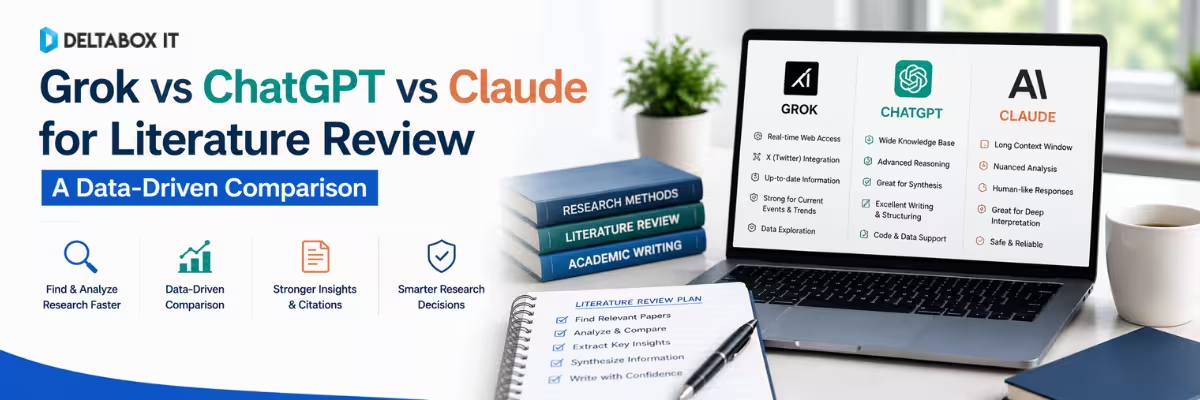
ChatGPT vs Claude vs Grok for Literature Reviews: Features, Accuracy and Workflow

A literature review requires more than summarising a folder of research papers. Researchers must define a focused question, find relevant studies, evaluate source quality, compare methodologies, identify agreement and disagreement, verify citations and organise the evidence into a defensible academic argument.
ChatGPT, Claude and Grok can assist with parts of this workflow. All three can analyse documents, explain complex material, organise findings and support web-based research. However, they differ in source control, document workflow, citation presentation and suitability for current versus academic information.
For most literature-review projects, ChatGPT is the strongest all-round research workflow, particularly when the task combines uploaded files, selected websites and multi-step web research. Claude is especially effective for close analysis and synthesis of a defined collection of long academic documents. Grok is most useful for current web research, emerging discussions and topics connected to real-time information.
That does not make any of them a substitute for Google Scholar, Scopus, Web of Science, PubMed or a university library database. These are general AI research assistants, not dedicated scholarly indexes.
Important methodology note: This article is a feature-and-workflow comparison. It does not claim to be a controlled benchmark. A true data-driven comparison would require the same model conditions, prompt, source set, evaluation rubric and repeated tests across all three platforms.
Students who need a wider overview of dedicated discovery, citation and editing platforms can also read the guide to the best AI tools for research papers and literature reviews.
Quick Verdict: Which Is the Best AI for Literature Review?
| Research Need | Recommended Choice |
|---|---|
| Best overall literature-review workflow | ChatGPT |
| Best for analysing a controlled set of long papers | Claude |
| Best for current web and real-time topic discovery | Grok |
| Best source-selection control | ChatGPT |
| Best project-based document workspace | Claude |
| Best for social and emerging public discussion | Grok |
| Best for a structured cited research report | ChatGPT or Claude |
| Best for academic source verification | None—verify through original papers and scholarly databases |
The most practical decision is:
- Choose ChatGPT when you need source discovery, uploaded-file analysis, synthesis and report organisation in one workflow.
- Choose Claude when you already have the papers and want detailed comparison, thematic analysis or chapter-level review.
- Choose Grok when the topic is recent, fast-moving or influenced by current web and X discussions.
For serious research, the strongest workflow may use one of these assistants alongside a dedicated academic search platform and a citation manager.
How This Comparison Evaluates the Three Tools
This comparison focuses on the activities that affect literature-review quality:
| Evaluation Area | What Matters |
|---|---|
| Source discovery | Whether the tool can locate recent and relevant information |
| Source control | Whether the researcher can restrict the tool to selected sources |
| Document handling | How well it works with PDFs and multiple files |
| Citation traceability | Whether claims link back to inspectable sources |
| Synthesis quality | Whether it compares studies rather than listing summaries |
| Follow-up reasoning | Whether it can refine categories and resolve inconsistencies |
| Output organisation | Whether it creates useful tables, themes and report structures |
| Fabrication risk | Whether references or claims require additional verification |
No responsible comparison should judge the tools only by how polished the final prose sounds. A fluent answer can still contain weak evidence, missing context or inaccurate citations.
ChatGPT for Literature Reviews
ChatGPT offers the most complete general-purpose workflow of the three.
Its Deep Research feature can work with the public web, specific websites, uploaded files and connected applications. It first proposes a research plan, allows the user to review or change that plan and then produces a structured report with citations or source links. Researchers can also restrict a task to selected domains or prioritise specified sources.
This source control is valuable for literature reviews. A researcher could instruct ChatGPT to use uploaded papers together with selected journal websites, university repositories or government research portals while excluding general commercial content.
ChatGPT also supports common academic and office file formats, including PDF, DOCX, PPTX, spreadsheets and text files. It can extract information, compare documents and combine findings across uploaded material.
Where ChatGPT Performs Best
ChatGPT is most useful when the researcher needs to move between several stages:
- Narrowing a research topic
- Developing search terms
- Finding current sources
- Comparing uploaded papers
- Building an evidence matrix
- Organising themes
- Reviewing a draft section
Its major strength is flexibility. The same workspace can support planning, search, file analysis, tables, synthesis and writing improvement.
A strong use case would be to upload eight selected papers and ask ChatGPT to extract the population, study design, sample, findings and limitations into a structured table. The researcher could then request a thematic synthesis based only on those verified sources.
Main Limitation
ChatGPT can produce inaccurate information and may fabricate quotations, studies, citations or references. OpenAI advises users to verify important claims and treat the output as a starting point rather than a final source.
Therefore, a ChatGPT research paper workflow should use either uploaded verified papers or research modes with visible sources. An uncited answer from general model knowledge is not sufficient for academic evidence.
Students interested in its broader research workflow can review the current ChatGPT Plus subscription options in Bangladesh.
Editorial verdict: Best overall choice for mixed literature-review tasks involving research planning, web sources, files and structured reporting.
Claude for Literature Reviews
Claude is particularly strong when the researcher already has a defined body of literature.
Claude supports PDFs, Word documents, spreadsheets, text files, EPUB files and several other formats. Users can add documents directly to chats or place them in a Project knowledge base for repeated analysis. Claude Projects provide a dedicated workspace with their own instructions, conversations and reference materials. When project knowledge grows, Claude can use retrieval-based processing to work across a larger collection.
For a thesis or literature review, this makes Claude useful as a persistent source-analysis environment. A researcher can place selected papers, methodology notes and an evidence table into one Project, then ask a series of connected questions without rebuilding the context every time.
Claude also offers a Research feature that performs multiple connected searches across the web and supported internal sources. It returns cited answers and works through different aspects of a question rather than relying on one search.
Where Claude Performs Best
Claude is well suited to tasks such as:
- Comparing arguments across several long papers
- Identifying methodological differences
- Developing a thematic literature-review structure
- Reviewing contradictions between studies
- Analysing a thesis chapter against source materials
- Reorganising dense evidence into readable academic prose
Its responses often work well when the researcher provides clear boundaries, such as:
Use only the attached eight papers. Organise the findings into three themes, cite the supporting paper for each claim and identify evidence that contradicts the dominant conclusion.
Claude is also useful for follow-up reasoning. Once an initial synthesis is created, the researcher can ask it to split an overly broad theme, distinguish population differences or identify claims supported by only one study.
Main Limitation
Claude’s analysis remains dependent on the quality and completeness of the supplied source set. A well-written synthesis can still omit a paper, misunderstand a table or overstate agreement.
Anthropic advises users to cross-check citations and consult authoritative sources when accuracy matters.
Researchers can review the available Claude AI subscription options in Bangladesh.
Editorial verdict: Best choice for close reading, long-document comparison and repeated analysis within a controlled research project.
Grok for Academic Research
Grok’s clearest advantage is access to current information.
Grok can search the broader web and information from X, and its search results can include citations that allow users to inspect the referenced webpages or posts. Its real-time orientation can be useful for emerging technology, policy debates, current events and topics where recent public discussion matters.
Current Grok interfaces also support common files such as PDFs, Word documents, spreadsheets, presentations and text files. Official documentation describes multi-document search and the ability to analyse, extract and summarise uploaded content.
This means Grok for academic research can support both current web discovery and source analysis.
Where Grok Performs Best
Grok is most relevant when the literature-review topic includes a fast-moving public-information layer.
Examples include:
- Public reactions to new AI regulation
- Emerging technology adoption
- Recent platform-policy changes
- Online discourse surrounding a research issue
- Current industry announcements
- Events not yet well represented in peer-reviewed literature
For these topics, Grok may help identify terminology, recent reports, public claims and discussion patterns that can guide a later academic search.
Main Limitation
Real-time information is not the same as scholarly evidence.
X posts, news articles, company announcements and web commentary may be current but lack peer review, methodological transparency or stable evidence. Grok should therefore separate academic sources from public discussion rather than blending them into one conclusion.
xAI has also acknowledged that Grok can generate false or contradictory information even when it has access to search tools and real-time data.
Students can check current Grok AI subscription options in Bangladesh.
Editorial verdict: Best choice for emerging topics and real-time context, but not the strongest standalone option for a conventional academic literature review.
ChatGPT vs Claude vs Grok: Feature Comparison
| Feature | ChatGPT | Claude | Grok |
|---|---|---|---|
| Web research | Strong | Strong | Strong, with real-time orientation |
| Research planning | Strong, with editable research plans | Strong agentic research | Useful, but workflow depends on mode |
| Specific-site control | Strong | Can use direct links and web search | General web and X search |
| Uploaded-file analysis | Strong | Strong | Strong |
| Persistent project workspace | Projects and file library | Strong Project knowledge workflow | File and workspace capabilities available |
| Long source-set synthesis | Strong | Particularly well suited | Capable |
| Academic citation verification | Manual verification required | Manual verification required | Manual verification required |
| Emerging-topic research | Strong | Strong | Strongest differentiator |
| Conventional literature review | Best all-round | Best controlled-source analyst | Better as a supporting tool |
| Risk of unsupported claims | Present | Present | Present |
This table reflects product capabilities and workflow suitability. It is not a measured model benchmark.
Which Tool Has Better Citation Accuracy?
None of the three can guarantee citation accuracy.
ChatGPT and Claude provide citations in their dedicated search and research modes. Grok also supports cited web results. These features improve traceability because the researcher can open the source rather than rely entirely on generated prose.
However, visible citations do not prove that:
- The source is academic
- The cited passage supports the exact claim
- The study population matches the research question
- The result has been interpreted correctly
- The source is not outdated or retracted
- The citation represents the wider body of evidence
The correct measure of AI citation accuracy is not whether a link appears. It is whether the source exists, is appropriate and directly supports the statement.
For central claims, open the original paper and verify the title, authors, method, population, findings and limitations.
Which Tool Is Better for Source Analysis?
When the same verified source set is used, Claude has a slight workflow advantage for close, repeated document analysis, particularly through Projects. ChatGPT is more versatile when the source set must be combined with controlled web research. Grok can analyse multiple files but offers its clearest additional value when current web or X context is relevant.
| Source-Analysis Scenario | Best Choice |
|---|---|
| Eight uploaded journal papers | Claude |
| Uploaded papers plus selected websites | ChatGPT |
| Research papers plus current online discussion | Grok |
| Repeat analysis across a thesis project | Claude |
| Research plan, discovery and final report | ChatGPT |
| Emerging issue with limited published research | Grok |
These recommendations are editorial judgments based on available workflow features, not controlled performance scores.
Recommended Literature-Review Workflows
Workflow 1: Traditional University Literature Review
Start with a scholarly database rather than an open chatbot. Find and verify the papers, then upload the strongest sources to Claude or ChatGPT.
Use the AI assistant to extract comparable information and organise themes. Finally, return to the original papers before writing each important claim.
Recommended choice: Claude for source analysis or ChatGPT for the broader workflow.
Workflow 2: Literature Review on a Current Topic
Use ChatGPT or Grok to identify recent terminology, events and public reports. Then search academic databases for peer-reviewed studies using the discovered terms.
Keep current web evidence separate from scholarly evidence in the final paper.
Recommended choice: ChatGPT for controlled multi-source research; Grok when live public discussion is central.
Workflow 3: Thesis Chapter Revision
Upload the chapter together with the verified papers supporting it. Ask the tool to identify unsupported claims, repeated arguments and areas where the cited evidence does not match the wording.
Recommended choice: Claude for detailed source comparison; ChatGPT for a structured citation audit.
How to Run a Fair ChatGPT vs Claude vs Grok Test
A genuine data-driven comparison requires controlled conditions.
Use the following process:
- Select the same five to eight academic papers.
- Upload identical file versions to all three tools.
- Use the same prompt and output format.
- Disable open-web search during the source-set test.
- Run each prompt more than once.
- Score the output using a fixed rubric.
- Verify every factual claim against the papers.
Your evaluation table can include:
| Test Area | Scoring Question |
|---|---|
| Source accuracy | Did the answer use the correct paper? |
| Citation accuracy | Does the cited passage support the claim? |
| Fabrication | Did it introduce information absent from the sources? |
| Synthesis | Did it compare studies instead of summarising separately? |
| Method awareness | Did it distinguish design, sample and limitations? |
| Organisation | Was the output usable for a literature review? |
| Follow-up reasoning | Did it correct or refine the analysis when challenged? |
Without this process, claims such as “Claude is 30% better” or “Grok is the most accurate” would be unsupported.
Reusable Literature-Review Prompt
Use only the attached academic papers. Create a thematic literature synthesis addressing [research question]. For each theme, identify the studies that support it, studies that disagree and methodological differences that may explain the disagreement. Do not introduce external facts or references. Provide a table containing author, year, population, method, sample, principal finding and limitations. Flag any information that cannot be confirmed from the supplied sources.
After receiving the answer, follow with:
Audit the previous response. List every claim that is not directly supported by the attached papers and show the exact source passage supporting each remaining claim.
This second step is important because confident initial synthesis may hide weak source alignment.
Final Verdict: What Is the Best AI for Literature Review?
ChatGPT is the best overall choice for literature reviews when the workflow includes research planning, controlled web search, uploaded documents, evidence organisation and structured reports.
Claude is the better specialist choice for analysing a defined source collection. Its project-based document workflow is particularly useful for thesis writers and researchers who need repeated analysis of the same papers.
Grok is the better supporting choice for emerging or current topics. Its access to real-time web and X information can reveal recent developments and public discussion, but those sources must be separated from peer-reviewed evidence.
The final choice should follow the research task:
- Complete mixed workflow: ChatGPT
- Deep source-set analysis: Claude
- Current and emerging context: Grok
Students can explore more AI tools available in Bangladesh or compare broader Education and Research tools before choosing a subscription.
DeltaBox IT is an independent third-party digital-product provider. It does not own, develop or control ChatGPT, Claude or Grok. Features, usage limits and availability remain subject to the respective platform providers.
Frequently Asked Questions
Is ChatGPT or Claude better for literature reviews?
ChatGPT is better for an end-to-end workflow involving source discovery, web research, uploaded files and report creation. Claude is particularly strong when the researcher already has a controlled source set and needs detailed comparison or thematic synthesis.
Is Grok good for academic research?
Grok can support academic research through web search, citations and document analysis. Its strongest differentiator is current and real-time information. Researchers should not treat posts, news or web commentary as equivalent to peer-reviewed studies.
Which AI is best for analysing research papers?
Claude is a strong option for close analysis of several long papers. ChatGPT is more flexible when document analysis must be combined with broader research and structured reporting.
Can ChatGPT create a literature review?
ChatGPT can help search, organise and synthesise literature. The researcher must still find suitable scholarly sources, verify citations, evaluate methods and write the final academic interpretation.
Can Claude summarise multiple research papers?
Yes. Claude can work with multiple uploaded documents and Project knowledge bases. The completeness and accuracy of the synthesis still depend on the supplied papers and the verification process.
Does Grok provide citations?
Grok can include citations in web-based answers and draw information from X and the broader internet. Users should open each source and evaluate its credibility before using it academically.
Which AI has the most accurate citations?
No platform can guarantee accurate citations. Research modes with visible source links improve traceability, but every reference and supporting passage must be checked manually.
Can these tools replace Google Scholar?
No. ChatGPT, Claude and Grok are general AI assistants. Literature reviews may still require Google Scholar, institutional databases and subject-specific scholarly indexes.
How can I prevent fabricated references?
Use verified uploaded papers, request source-linked research, prohibit external references where necessary and manually check every author, title, journal, year and DOI.
Where can students access these AI tools in Bangladesh?
Students can review current ChatGPT Plus, Claude AI and Grok AI subscription options and confirm the access type, plan duration, limits and current availability before ordering.
Choosing between ChatGPT, Claude and Grok for a literature review? Start with your main bottleneck: source discovery, document analysis or current web research.
Review the relevant package details before selecting a tool. For current availability, access conditions or package guidance, contact DeltaBox IT through WhatsApp.

MD. Nayeem-Ur Rahman
Related posts












Leave a Reply Cancel reply
You must be logged in to post a comment.



One thought on “ChatGPT vs Claude vs Grok for Literature Reviews: Features, Accuracy and Workflow”